Sachets — single-serve powders and granulates for daily-ritual ranges.
Powder and granulate concepts portioned into single-serve sachets and stick packs. Fill weight, film and outer presentation are confirmed per project inside one project-managed workflow.
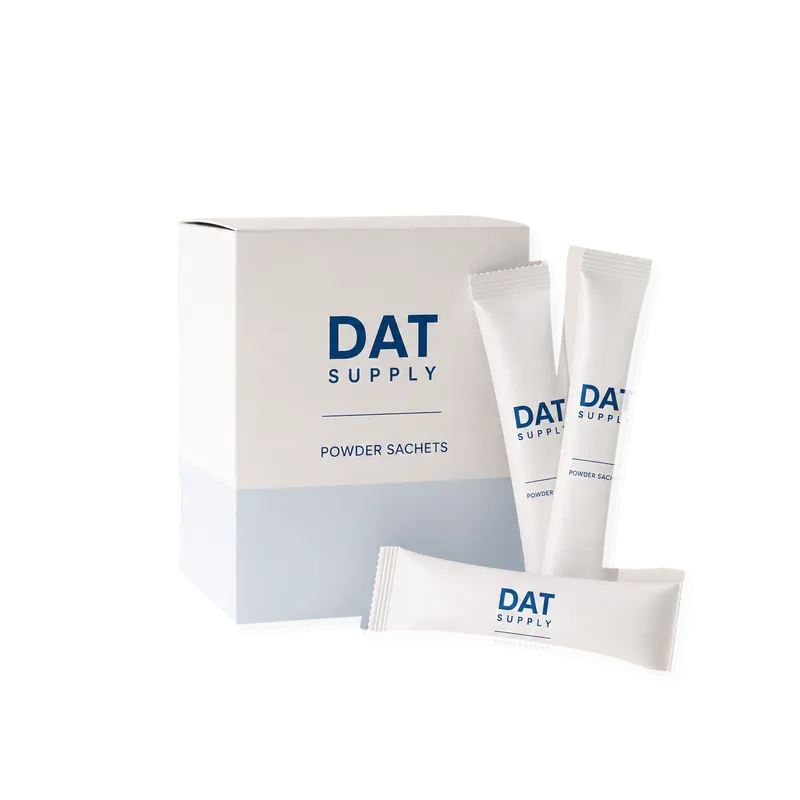
Sachets turn a powder or granulate concept into a portable single-serve ritual. Fill weight, film structure and outer packaging are reviewed up front so the sachet behaves the same in spec as it does in the hand.
When a sachet fits
Sachets suit powder and granulate concepts that benefit from a portion-controlled single serve, a travel-friendly format, or a daily-ritual SKU where the dose is poured, mixed or taken direct.
- Daily-ritual powders portioned into single-serve sachets or stick packs.
- Travel and on-the-go SKUs where a portable single serve is the brand promise.
- Effervescent, instant-drink or mix-in-water concepts that need portion control.
- Trial and sampling SKUs paired with a hero range in another format.
How DAT sachets are manufactured
A sachet portions a powder or granulate concept into a single-serve pouch. The fill is the spine of the format — a dry blend of actives, carriers, flow aids, sweeteners and flavour reviewed for particle size, bulk density, flow behaviour and dissolution before the configuration is confirmed. The platform handles instant drink powders, effervescent blends, greens and superfood mixes, electrolyte serves, collagen and protein single serves, and granulate concepts taken direct. Film structure is matched to the fill — moisture- and oxygen-sensitive actives need a higher-barrier laminate, while a simpler structure suits a robust dry blend; the brief confirms the right film. Fill weight, sachets per unit, seal type (three-side, four-side or stick) and the outer carton are all confirmed per project. Brands choose sachets when portion control, portability and a daily-ritual read matter more than a multi-serve jar — a greens stick for the gym bag, a magnesium drink for the bedside, a collagen serve for travel. The format trades the per-unit economics of a bulk powder for a portion-controlled single serve and a stronger ritual story; the brief review confirms the fill flows and seals cleanly before spec lock.
Pick the option that matches the brief.
Every project moves through one of two options. Final routing is confirmed inside the portal — the option shapes the documentation set and the timeline.
Reviewed concept, your brand.
Pick a reviewed concept from the catalogue and add your brand. The fastest path from brief to launch — packaging, claims and documentation are reviewed against the target market. Project-specific packaging, flavour, colour or shape adjustments may be reviewed after order start.
- Best for
- First SKU · short timelines
- Lead time
- From 8–12 weeks
Bespoke formulation and dieline.
Fully bespoke formulation, custom flavour profile and packaging dieline. Runs as Custom Product R&D — a paid development package scoped before work starts; the right option for category-defining launches with longer planning windows and committed quantities.
- Best for
- Category-defining launch · committed quantities
- Lead time
- Final timeline is confirmed during order setup.
What each option looks like for sachets
Private-label is supported for sachets — reviewed powder concepts already in the catalogue can carry brand artwork directly. First runs land at the 1,000-unit MOQ tier and DAT confirms fill weight, sachet format (flat or stick) and outer pack in the brief. This route suits ranges that want a recognised single-serve ritual fast: a greens stick, an electrolyte serve, a daily collagen.
Custom sachet development covers novel blends, effervescent or instant systems that need their own qualification, premium sourcing, or a bespoke film and stick-format presentation. Brief review confirms the fill flows and seals before spec lock; first-run volumes are confirmed after the development scope. Timelines are scoped in the R&D package.
Sachet · Stick pack · Outer carton
Sachet configuration is confirmed per project — film structure, fill weight, sachets per unit and outer presentation are reviewed alongside the fill.
Sachet packaging is reviewed as a system around the fill. The film carries the shelf life — moisture- and oxygen-sensitive powders need a higher-barrier laminate, effervescent blends need a tight moisture barrier, and a robust dry blend can run a simpler structure. Flat sachets (three- or four-side seal) suit wider single serves; stick packs read slim and travel-first for pour-and-go rituals. Fill weight, sachets per unit and the outer carton or shipper are confirmed per project against the target retail and logistics envelope. Tamper evidence, easy-tear notches, recyclable mono-material options and on-pack QR codes are all routinely reviewed, and artwork is reviewed against the target-market framework before production. The brand owner remains the food business operator on pack.
- Flat sachet
Classic three- or four-side-seal sachet for single-serve powders and granulates.
- Stick pack
Slim single-serve stick for pour-and-go or direct-to-mouth rituals.
- Outer carton
Multi-sachet carton for retail and subscription cadence. Count per pack confirmed per project.
- Flat sachet (3/4-side seal)
- Stick pack (single-serve)
- High-barrier laminate
- Easy-tear notch
- Multi-sachet outer carton
- Tamper-evident outer
- Recyclable mono-material
- On-pack QR / batch code
Reviewed concepts for this format
A short pick of reviewed concepts. Final positioning, claims and documentation are confirmed per project.
-
Daily greens stick pack
Single-serve greens powder for a pour-in-water ritual.
-
Magnesium drink sachet
Mix-in-water magnesium serve for evening routines.
-
Collagen sachet
Single-serve beauty collagen for travel-friendly ranges.
Top actives for sachets
Ingredients commonly reviewed for this format. Open a dossier to see dose anchors, working forms and formulation notes.
Other formats in the formats & delivery group
Adjacent manufacturing formats DAT supports across the same product family.
Common actives for this format
Frequently asked questions
What can a sachet carry?
Powders and granulates — daily-ritual blends, drink mixes, effervescent or instant concepts. Fill weight, flow behaviour and dissolution are reviewed against the active stack before spec lock.
What is the difference between a flat sachet and a stick pack?
A flat sachet is a wider three- or four-side-seal pouch; a stick pack is a slim single-serve format that suits pour-and-go or direct-to-mouth rituals. The right choice depends on fill volume and the brand ritual, and is confirmed during the brief.
Is a private-label option available for sachets?
Yes — sachets are available as private-label or custom options. Private-label suits reviewed powder concepts the brand can adopt as-is; dose and flavour tuning routes through personalisation.
What documentation review steps apply?
Brief review, spec confirmation, artwork review per the target-market framework, and batch-specific Certificate of Analysis after QC release. The brand owner remains the food business operator on pack.
What is the order of magnitude for a first run?
Private-label projects start from 1,000 units (doypack from 2,500); project-specific personalisation is reviewed inside a normal order. Custom development volumes are confirmed after the development scope. Final volumes are confirmed during order setup.
What base does the DAT sachet platform use?
The platform is a powder blending and single-serve filling system: actives, carriers and flavour systems are dry-blended to a homogeneous mix, then dosed into foil-laminate sachets or stick packs whose moisture barrier protects the blend through shelf life. Because the serve is measured at fill rather than shaped into a piece, the format carries gram-level payloads confectionery formats cannot — full electrolyte stacks, creatine servings, greens blends and collagen doses ride comfortably. Flavour work centres on how the blend drinks: sweetener system, acidity and mouthfeel are tuned against the mixing liquid, and mixability itself — how cleanly the powder disperses without clumping — is part of the sample review. Sugar-free builds on polyols and high-intensity sweeteners are standard where the actives tolerate them.
Which products suit a powder sachet or stick pack?
Serving-controlled daily powders lead the lane: hydration and electrolyte mixes, creatine and pre-workout servings, greens and superfood blends, collagen beauty servings and kids multivitamin powders all appear in the reviewed catalogue. The common thread is a dose too large or too flexible for a chewed format, drunk rather than eaten. Where the concept needs a countertop ritual in one gesture without a glass, the functional jelly stick is the adjacent lane — the brief review places each concept in the right format.
Continue exploring
Private-label framing, related formats and the public-ready catalogue.
- Private label
Private label powder sachets →
Reviewed concepts in this format, pivoted for the private-label brand owner. Same four-step documentation route, catalogue-led.
- Related format
Functional jellies manufacturing →
Pouchable functional jelly format for daily-routine and on-the-go supplement concepts.
- Related format
Oral strips manufacturing →
Fast-dissolving oral strip format. Reviewed per project; payload range confirmed during the brief.
- Catalogue
Browse powder sachets concepts →
Every public-ready PIM concept detected as powder sachets, sorted by family for quick scanning.
Start a sachet manufacturing project
Send the brief — DAT will review the fill, confirm the working route and frame the sachet configuration inside the project workflow.